

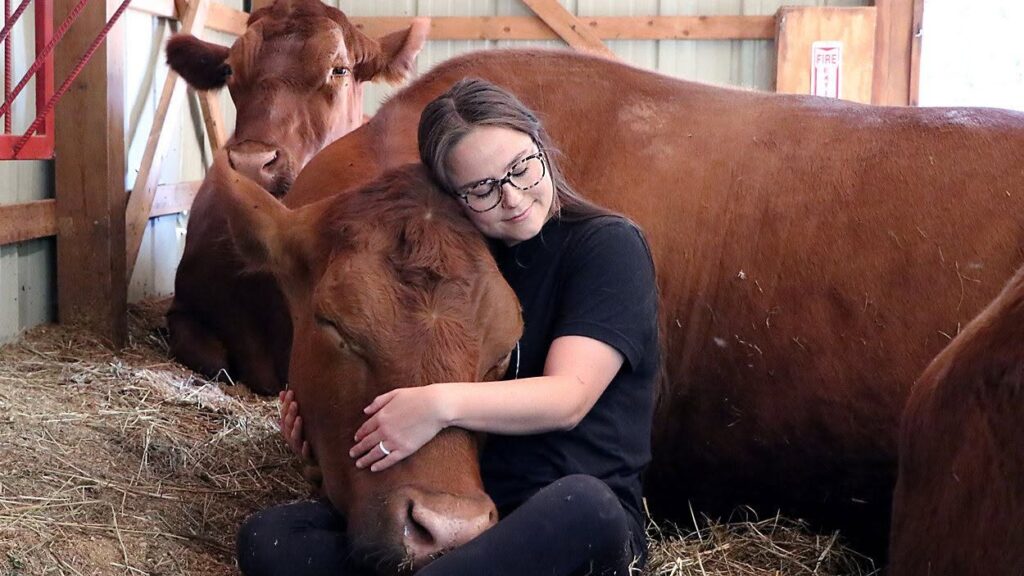
A permaculture food revolution starts with something very simple: we stop viewing other animals as a resource to exploit.
Right now, most animal agriculture is built on systems of confinement, control, and violence. Animals are bred into existence, their bodies managed like production units, and their lives end in slaughter. What reaches the plate is not just “food,” but the result of animal abuse, enslavement, and systemic oppression.
It is hard to soften what is actually happening. Chickens, pigs, cows, fish are not treated as individuals with their own right to live free from harm. They are treated as property. Their lives are controlled from birth to death, and their bodies are turned into carcass and flesh. Their reproductive systems are exploited, including secretions like milk produced through forced bovine lactation, or eggs taken continuously from hens’ bodies.
If we are serious about justice, this has to be part of the conversation. Because these are not small details. They are rights violations of sentient beings who experience fear, pain, comfort, and the desire to live.
Speciesism is what allows this to feel normal. It is the belief that a being’s moral value depends on its species rather than on its capacity to suffer. It draws an invisible line that says one group gets full moral consideration, and the rest can be used.
Permaculture, at its core, is supposed to be the opposite of that mindset. It is about designing systems that are stable, regenerative, and respectful of life. But it is impossible to call a system truly regenerative if it depends on slaughter, animal exploitation, and ongoing harm to others.
That is why many people are now calling for a full shift away from animal agriculture and industrial fishing. Not as a small adjustment, but as a real break from systems built on domination. The goal is to move toward food systems based on diverse plant agriculture, food forests, and ecosystems that can actually heal over time.
This is not about perfection or purity. It is about honesty.
If we already know that animals are not things, then continuing to treat them as things becomes harder to justify. If we already know the planet is under pressure, then systems that rely on massive land use, emissions, and ocean destruction become harder to defend.
So the call is straightforward:
Stop normalizing animal abuse as “food production.” Stop pretending oppression is invisible when it is built into the system. Start designing food systems that do not require slaughter or exploitation at all.
Ethical veganism, in this view, is not an extreme position. It is the logical endpoint of taking animal rights seriously and applying them consistently.
A permaculture future should not be held together by violence. It should be held together by living systems that do not require victims. Veganism is basic morality